So, once again, I let this place get dusty.
I'm horrible at keeping up at this.
I thought I'd shake things up and move to Tumblr, but then I thought better about it, and decided I'd live with the misspelled URL. It's "character." I'm familiar here, and I like this set-up most.
Maybe there will be some new posts here again. I've GOT things I want to write about, but I keep getting distracted. Sorry 'bout that.
Monday, June 14, 2010


Friday, February 19, 2010
Funhouse
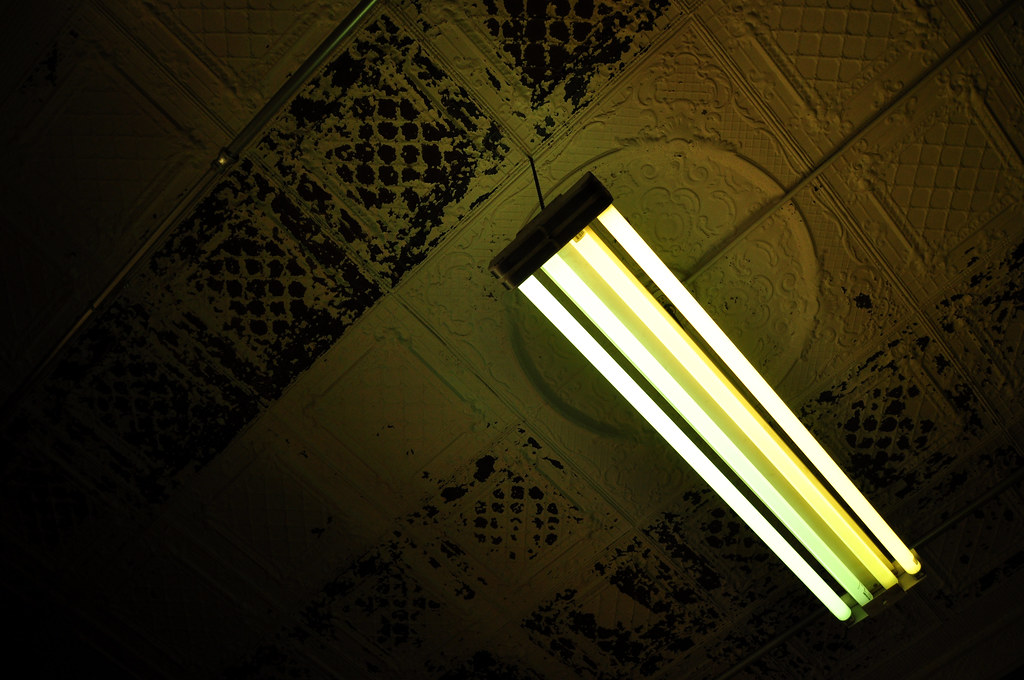
It's three buildings and two floors and a good quarter block of tin ceilings, old fittings, a labarynth of narrow corridors and old shelves stocked with almost everything that you can imagine, and everything you can't find in your standard nation-wide chain hardware stores.
But, I don't really go there to shop (although, when I was there yesterday I did buy a stopper-plug for my bathroom sink, so that I can convert it into a rinsing tank for when I do my cyanotype prints.) Being a photographer who likes old things - I go there to take pictures.
Most stores, when you whip out a camera and take off your lens cap (There are very few stores I'd actually do that in, most just don't appeal to me.) will ask you to either put away the camera, or leave. The people at Travis see you with a camera, and they'll even suggest places around the store that have some neat, photogenic stuff in it. They've even hosted bevies of college photography students who comb through the old, well-worn, but well-loved labarynth for good shots. It's no wonder, as the possibilites there are endless, as there's just so many things to look at, which have all been there since the beginning
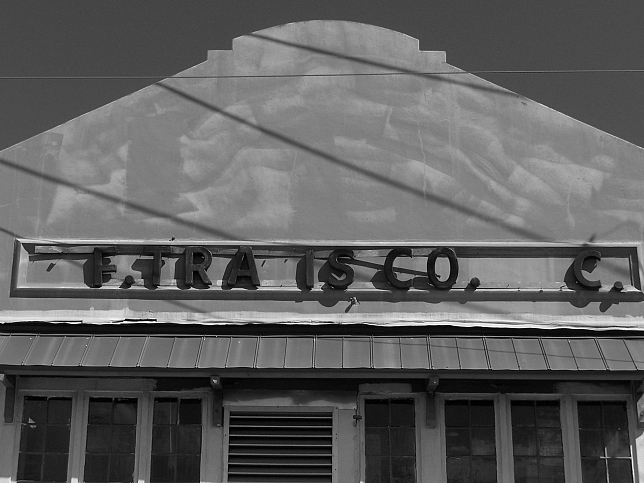
Each building has its own individual staircase, and each building is connected to one another through various means. This is where the fun part comes in: in the summer months, you can traverse a sloping, slanted skybridge across the separation from the 1907 building to the the 1916 building which drops you right in front of what had been a freight elevator. The front of the second floor of this building has a plain tin ceiling painted in mellows colors that remind me of the cast-iron buildings of New York City. Down the stairway and out the rear of the building, across a narrow yard, you come to a covered area, which is the traffic hub of Travis's employees, the confluence of all walking traffic between the three buildings. Here, you'll see to your left a narrow hallway that is barely shoulder-width. It takes a hard right, over a grate into which rainwater drains from the gutter, and there is the pipe room. At the very end of the long, narrow outbuilding is where the original riverbank of the river was located, and where the complex was accessible to barges going up and down the river. The whole complex once sat directly on the riverfront of Cocoa.
But, that, along with many other things around Travis Hardware has changed. The river was filled in and now the riverbank is basically two blocks to the east from the rear of the property. All but one of the buildings directly in front of the store have either burned down or been demolished, and the hotel, bandstand, and numerable other businesses and storefronts have disappeared, since replaced by the east and westbound lanes of State Road 520.
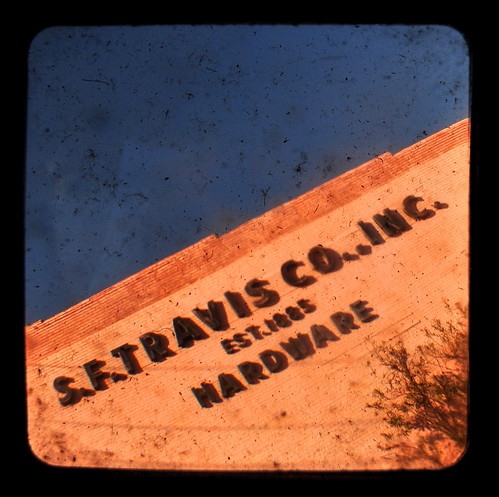
So, go down there and have a look around. They're on the southeast corner of Delannoy Avenue (or State Hwy 515) and King Street (eastbound State Rd. 520) in downtown Cocoa. They're all very friendly, and will know exactly where something is if you're looking for something hardware-related. Take some pictures, and buy something, even. I'm sure they'll appreciate it.
Wednesday, February 10, 2010
Grove Land
Grove Land
Originally uploaded by Decrepit Telephone
Some people consider it progress, and nice for property values. It probably is. Others compliment the landscaping around the entrances to these places. I find it unappealing, and, quite frankly, depressing. I find it sad that a state with such a diverse regional flavors is losing its soul to the sprawl to the outdated theory of failed post-war urbanism (or suburbanism). I know that's a lot of big words to throw about, but, it's true. This state is becoming one large, homogenous subdivision.
And a great deal of that homogenous subdivision was built on thousands upon thousands of citrus groves.
Which is why seeing these groves outside of LaBelle, in the southwestern-central part of the state was so reassuring. To see the thousands of acres of still functioning, maintained groves was comforting, confirming that Florida still has a great deal of its agricultural heart left that's still beating. For how long, I don't know, but I was happy to see it at least still around for a little longer.
But still, I wish my area still had them. They were pretty. And in the spring, when the acres and acres were blooming, it left the air heavy with the scent of citrus. It's heavenly. I just wish more people would be able to experience that.
______________________________
I know it's been a while since I posted something here, but I've been busy and stuff - visiting family, that kind of thing. Well, relatively busy. But you get the idea.
Tuesday, January 19, 2010
Improvement in Parasols
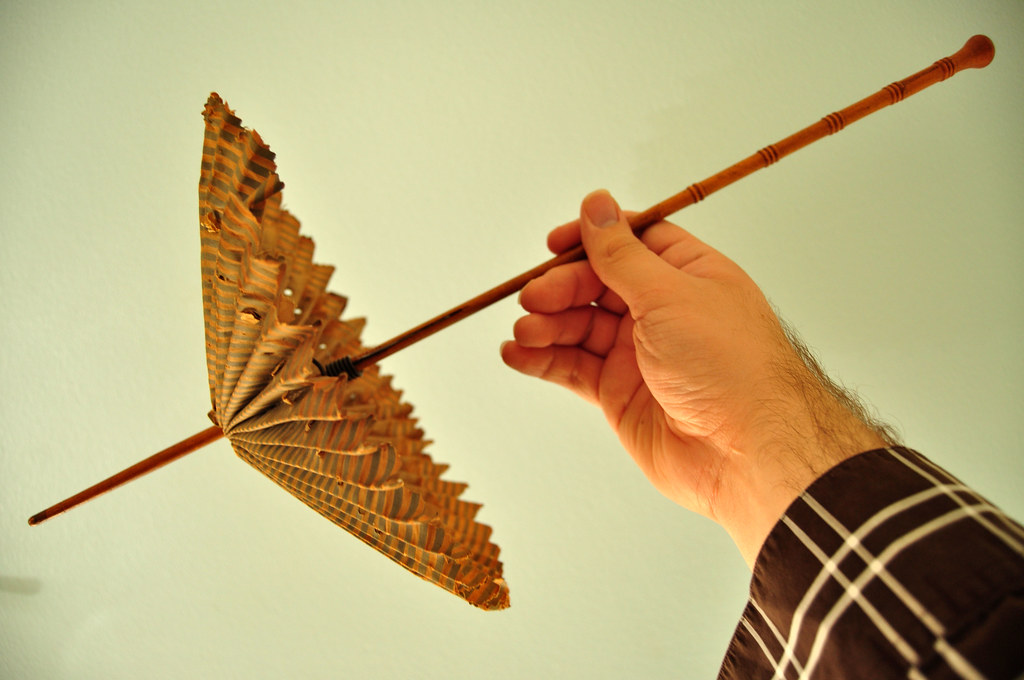
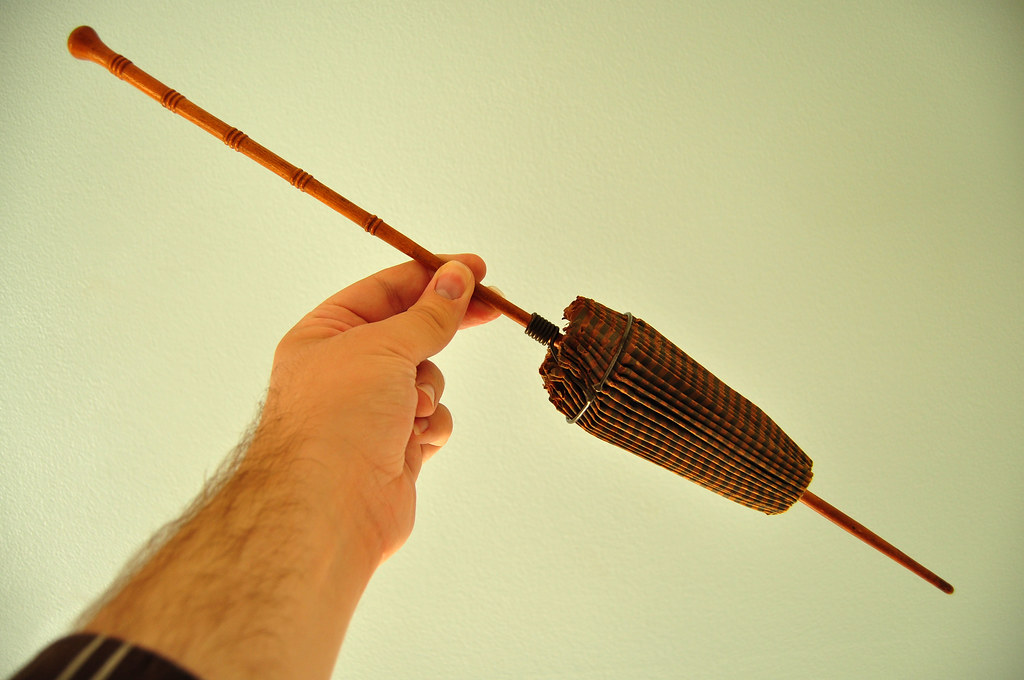
My latest antiques buy was an eBay find, it was so unusual I had to bid on it, unsure if it was a parasol, as the seller thought, or if it was a hand held fire screen, similar to some ivory-handled examples I had seen about a year ago.
When it arrived, though, it became pretty clear that a fire-screen this was not. It's a parasol for sure. But it was very much unlike any other example I had seen.
Plus, it had a patent date on it. And that got me started on my research.
Innovation was a Victorian specialty. Nineteeenth century philanthropists, home-spun and ivy-league educated, believed it could bring about social reform. Those whose aspirations were less high-minded pursued innovation to seek fortune, or to make life more convenient.
The inventor as a hero reached its peak during the nineteenth century. While it was Alexander Graham Bell and Thomas Edison who have become today’s household names of nineteenth century innovators, the everyday man was getting into the act as well.
The result of this is hundreds of thousands, if not millions of patents for every kind of object, apparatus and gadget. Most of these patents were placed in archives, and today are searchable online. This made things really easy for me.
The patent date on the turned, lightly colored wooden handle, was December 24th, 1867. A couple internet inquiries matched this date to a patent issued to a Cornelius St. John of Charlestown, Massachusetts.
Cornelius St. John has a number of patents on file. Not including the patent that he was issued for the design of this parasol, he was issued a patent for a lamp (Pat. No. 72242, Nov. 19th, 1867), a lamp burner (Pat. No. 75483, March 10th, 1868), and most unusually a device for self-teaching of the Harmonica (Pat No. 176124, 1876). By 1876, St. John had moved from Charlestown and had settled in Boston.
St. John appears to have been involved in some part with oil lamps during the late 1860s, as both patents for the lamp and lamp burner of 1867 and 1868 respectively indicate, as does his patent for the Improvement in Parasols (Pat. No. 72695) which indicates that the design of the folded canopy of the parasol is not unlike the paper lamp shades of a lamp. I’ve not yet been able to conclusively say what exactly St. John’s profession was at the end of the 1860s.
As the patent shows, the diminutive sunshade is opened by a metal ring which slides up and spreads the pleated canopy. This same ring holds the canopy closed when not in use. The canopy is a polished cotton material. I was surprised to find that the canopy was lined also with polished cotton. The outside is a brown and steel-blue, but looking in between the tight pleats toward the top of the canopy indicates that these stripes were originally azuline blue, of the extremely vivid, aniline dye variety.
So, it’s kind of neat. And in an odd coincidence, I was packing up the packing material leftover after I had unwrapped it, and noticed the return address. It came from Cold Spring, New York, where I spent a week in December of 2008 with a photographer friend of mine, and it came from the antique shop that my friend Jen and I went into one of the days on my visit, owned by an antique dealer who Jen took this portrait of. It put a smile on my face. I’m happy I helped support Cold Spring’s economy. Because I like Cold Spring.

When it arrived, though, it became pretty clear that a fire-screen this was not. It's a parasol for sure. But it was very much unlike any other example I had seen.
Plus, it had a patent date on it. And that got me started on my research.
Innovation was a Victorian specialty. Nineteeenth century philanthropists, home-spun and ivy-league educated, believed it could bring about social reform. Those whose aspirations were less high-minded pursued innovation to seek fortune, or to make life more convenient.
The inventor as a hero reached its peak during the nineteenth century. While it was Alexander Graham Bell and Thomas Edison who have become today’s household names of nineteenth century innovators, the everyday man was getting into the act as well.
The result of this is hundreds of thousands, if not millions of patents for every kind of object, apparatus and gadget. Most of these patents were placed in archives, and today are searchable online. This made things really easy for me.
The patent date on the turned, lightly colored wooden handle, was December 24th, 1867. A couple internet inquiries matched this date to a patent issued to a Cornelius St. John of Charlestown, Massachusetts.
Cornelius St. John has a number of patents on file. Not including the patent that he was issued for the design of this parasol, he was issued a patent for a lamp (Pat. No. 72242, Nov. 19th, 1867), a lamp burner (Pat. No. 75483, March 10th, 1868), and most unusually a device for self-teaching of the Harmonica (Pat No. 176124, 1876). By 1876, St. John had moved from Charlestown and had settled in Boston.
St. John appears to have been involved in some part with oil lamps during the late 1860s, as both patents for the lamp and lamp burner of 1867 and 1868 respectively indicate, as does his patent for the Improvement in Parasols (Pat. No. 72695) which indicates that the design of the folded canopy of the parasol is not unlike the paper lamp shades of a lamp. I’ve not yet been able to conclusively say what exactly St. John’s profession was at the end of the 1860s.
As the patent shows, the diminutive sunshade is opened by a metal ring which slides up and spreads the pleated canopy. This same ring holds the canopy closed when not in use. The canopy is a polished cotton material. I was surprised to find that the canopy was lined also with polished cotton. The outside is a brown and steel-blue, but looking in between the tight pleats toward the top of the canopy indicates that these stripes were originally azuline blue, of the extremely vivid, aniline dye variety.
So, it’s kind of neat. And in an odd coincidence, I was packing up the packing material leftover after I had unwrapped it, and noticed the return address. It came from Cold Spring, New York, where I spent a week in December of 2008 with a photographer friend of mine, and it came from the antique shop that my friend Jen and I went into one of the days on my visit, owned by an antique dealer who Jen took this portrait of. It put a smile on my face. I’m happy I helped support Cold Spring’s economy. Because I like Cold Spring.
Thursday, January 7, 2010
Overlook(ed)
I was shocked today when I was going through my archives and found that I hadn't posted this particular shot I had taken back when I went to Decatur Alabama back in September of 2008*. On the return leg of the trip, we stopped in Macon, Georgia. There, I found this large antebellum house named Overlook, sitting atop the hill. Standing on its wide verandah, it's not at all doubtful as to how the house got its name, as the view of the city from it is pretty impressive.
 That was what was really wonderful about going to Macon, is being surprised. I was surprised that the summerhouse was still there - because normally these things go away. Really fast. Such is the nature of most nineteenth-century garden structures: they don't have a good survival rate.
But what this post is about - to bring it to a quick wrap-up, is that I am surprised this house, and its grounds don't get more attention than they do. Overlook has to be the finest, and largest of the antebellum houses surviving in Georgia. If it's not the largest, or finest, then it is among those largest and finest that do survive in Georgia, and the South in general. Yet there is very little about it online, or in print that I am aware of.
Overlook no longer should be overlooked. It deserves to be done justice by its loveliness.
* Even I was a bit guilty of not giving it its proper due - because it took me nearly two years to realize I had never posted a photo of the house. Which is a bit bad because I really like this (and by this photo, I refer to the one at the top of the blog post) shot of it. I used to be really into the yellow filter (not a photoshop filter, but the actual screw-onto-the lens filter that photoshop can never match the effect of) and this trip fell in the peak of my yellow-filter addiction. It has since waned drastically, but I still take it out and use it on occaasion, and I still like it.

I had known about the house before, finding it (or, rather, its saracenic summer house) in John Maass's book The Victorian Home in America, the 1972 follow-up to his 1957 volume The Gingerbread Age: A Victorian View of America. (Maass's 1957 book is notable as being one of the first positive overviews of American nineteenth-century architecture and culture, after a half-century of retrospectives which had presented the American Victorian period in negative, scornful light.)
I was pleased, after some frustrating research (the building was renamed "Woodruff House" after it housed a private school/university in the 1960s and is listed on the National Register of Historic Places as such. This made researching the house as "Overlook" somewhat difficult.) to find that the house was still standing on its tall hill in central Georgia - but it was the summer house, with its wonderfully sinuous saracenic lines that I was concerned about the most. It was really special.
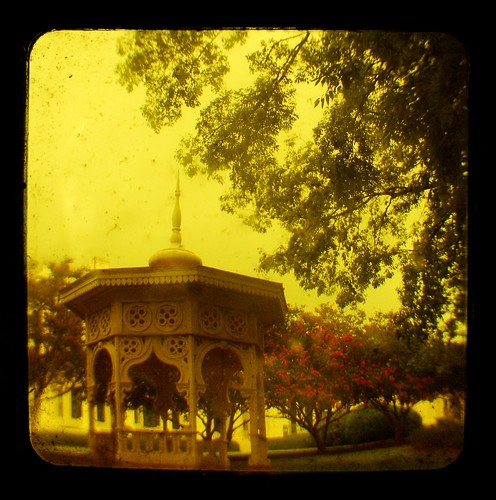 That was what was really wonderful about going to Macon, is being surprised. I was surprised that the summerhouse was still there - because normally these things go away. Really fast. Such is the nature of most nineteenth-century garden structures: they don't have a good survival rate.
But what this post is about - to bring it to a quick wrap-up, is that I am surprised this house, and its grounds don't get more attention than they do. Overlook has to be the finest, and largest of the antebellum houses surviving in Georgia. If it's not the largest, or finest, then it is among those largest and finest that do survive in Georgia, and the South in general. Yet there is very little about it online, or in print that I am aware of.
Overlook no longer should be overlooked. It deserves to be done justice by its loveliness.
* Even I was a bit guilty of not giving it its proper due - because it took me nearly two years to realize I had never posted a photo of the house. Which is a bit bad because I really like this (and by this photo, I refer to the one at the top of the blog post) shot of it. I used to be really into the yellow filter (not a photoshop filter, but the actual screw-onto-the lens filter that photoshop can never match the effect of) and this trip fell in the peak of my yellow-filter addiction. It has since waned drastically, but I still take it out and use it on occaasion, and I still like it.
Wednesday, January 6, 2010
And, I resurface
I finally resurface after a couple weeks of hiatus, but I had not abandoned this blog again! No, my hard drive on my laptop had died, so I was working off a surrogate for a few weeks - but things are back up and running and I have a posse of posts on the way over the next week or three. So, those who read this (although why I'm singling y'all out as those who don't read this probably don't even know of this blog) watch this space for more posts.
And my duh-of-the-day moment: I realized I had the title of this blog spelled wrong. There is no "tit" in "decrepitude" unless you're talking about old-lady boobs. Apologies for that joke - and the mental image created (gah!)
So if anybody noticed the misspelling, I'm really NOT an idiot, really I'm not.
And my duh-of-the-day moment: I realized I had the title of this blog spelled wrong. There is no "tit" in "decrepitude" unless you're talking about old-lady boobs. Apologies for that joke - and the mental image created (gah!)
So if anybody noticed the misspelling, I'm really NOT an idiot, really I'm not.
Thursday, December 17, 2009
Brains and Buckwheat
Yesterday, in Cocoa, I found a bunch of old nineteenth century readers, arithmetic and grammar books. They were fifty-cents each, and I had a field day. Some of them are in okay condition, but most are extremely beat up.
Not that it matters to me all that much. I'm one of those collectors who, if I like it, I buy it, no matter what the condition is, so long as I like it enough. I really don't worry about making sure everything I buy is pristine, and I don't really care about what other people say about buying things in good condition. If I like it enough, I'm going to get it.
I don't understand people who's collecting interests are based on what's popular or what's selling well, unless they're a seller of antiques themselves. If I limited myself to whatever was popular, then three years ago, when I last knew what was popular in the collecting world, I'd be restricted to buying depression glass and vintage costume jewelry. There's nothing wrong with either of those things, and they're interesting in their own right, but I'd never buy rhinestone pin or depression glass just because I knew it was popular. (Now, if it was dirt cheap, and I knew it was a good piece and had the possibility of reselling it, I would consider it. Yes, I would.)
I do what the collector friends I know do, I buy what I like and I don't care how anyone else thinks about it.
Like these schoolbooks - while they're not exactly falling apart, they aren't exactly pristine. Some collectors would turn their nose up at them, and pay a hundred times more for a pristine, clean copy, but I wouldn't. It's because they're used and they're beat up that I love them. Because when they were used, the schoolkids who used them wrote little bits of graffitti, and did their work on the back blank pages and wrote notes and silly commentary in the margins. Some kept things they were handed under the desk in them, such as the one book in the stack I bought that has an intricately hand-drawn valentine from 1894 left in the first few pages, drawn on fragile unruled notepaper. (Unfortunately I forgot to photograph this today, and now that it's dreary and rainy here, there's not enough light to work with, so it will have to wait for its own blog entry.)
They're really a record, little snippets of these kids' lives - kids who have already grown up, possibly had their own kids and raised them, and then died. It's kind of odd to go through reading the lessons that taught children who have already grown up and used that knowledge and passed on.
Such as the list in the picture at the top of this entry - it's a list of legal weights per bushel that was written down the back pages of an 1870 arithetic book, by a young Charles Wunderlich in Newell Missouri. Brain seems to be the only odd thing on the list, other than the two different types of corn listed (which I guess one was used for livestock feeding and the other used for home-consumption, or livestock feeding of a different type.) By the successive inscriptions on the front pages, it seems this book migrated to Cape Girardeau, Missouri and was used at a school there until at least 1888, where dozens of other students used the book and left their own marks and scribblings in it, left to be rediscovered over a hundred years later. It's these things, these little tidbits of these kids lives, and of life in the nineteenth-century, that people miss out on when they demand clean, unblemished old things.
I like stuff like this too much to miss out on it.
____________________
I know I've missed a couple days, or weeks on the blog-posting, but things have been getting hectic with Christmas at my heels. I have relatives visiting from South Carolina at the moment, and thought while they were out shopping I'd use the alone time two do some photoshooting and blogging today. Hopefully, I can get back onto the blog-wagon more regularly when things quiet down here some.

Not that it matters to me all that much. I'm one of those collectors who, if I like it, I buy it, no matter what the condition is, so long as I like it enough. I really don't worry about making sure everything I buy is pristine, and I don't really care about what other people say about buying things in good condition. If I like it enough, I'm going to get it.
I don't understand people who's collecting interests are based on what's popular or what's selling well, unless they're a seller of antiques themselves. If I limited myself to whatever was popular, then three years ago, when I last knew what was popular in the collecting world, I'd be restricted to buying depression glass and vintage costume jewelry. There's nothing wrong with either of those things, and they're interesting in their own right, but I'd never buy rhinestone pin or depression glass just because I knew it was popular. (Now, if it was dirt cheap, and I knew it was a good piece and had the possibility of reselling it, I would consider it. Yes, I would.)
I do what the collector friends I know do, I buy what I like and I don't care how anyone else thinks about it.
Like these schoolbooks - while they're not exactly falling apart, they aren't exactly pristine. Some collectors would turn their nose up at them, and pay a hundred times more for a pristine, clean copy, but I wouldn't. It's because they're used and they're beat up that I love them. Because when they were used, the schoolkids who used them wrote little bits of graffitti, and did their work on the back blank pages and wrote notes and silly commentary in the margins. Some kept things they were handed under the desk in them, such as the one book in the stack I bought that has an intricately hand-drawn valentine from 1894 left in the first few pages, drawn on fragile unruled notepaper. (Unfortunately I forgot to photograph this today, and now that it's dreary and rainy here, there's not enough light to work with, so it will have to wait for its own blog entry.)
They're really a record, little snippets of these kids' lives - kids who have already grown up, possibly had their own kids and raised them, and then died. It's kind of odd to go through reading the lessons that taught children who have already grown up and used that knowledge and passed on.
Such as the list in the picture at the top of this entry - it's a list of legal weights per bushel that was written down the back pages of an 1870 arithetic book, by a young Charles Wunderlich in Newell Missouri. Brain seems to be the only odd thing on the list, other than the two different types of corn listed (which I guess one was used for livestock feeding and the other used for home-consumption, or livestock feeding of a different type.) By the successive inscriptions on the front pages, it seems this book migrated to Cape Girardeau, Missouri and was used at a school there until at least 1888, where dozens of other students used the book and left their own marks and scribblings in it, left to be rediscovered over a hundred years later. It's these things, these little tidbits of these kids lives, and of life in the nineteenth-century, that people miss out on when they demand clean, unblemished old things.
I like stuff like this too much to miss out on it.
____________________
I know I've missed a couple days, or weeks on the blog-posting, but things have been getting hectic with Christmas at my heels. I have relatives visiting from South Carolina at the moment, and thought while they were out shopping I'd use the alone time two do some photoshooting and blogging today. Hopefully, I can get back onto the blog-wagon more regularly when things quiet down here some.
Saturday, December 5, 2009
Service
This was taken in the little southeastern Georgia town of Alma, a once busy farming town, now a town of empty storefronts, and empty streets. It's a town that still holds on, but I'm pretty certain that the busy days when my Grandma and Grandpa dated there, aren't going to be returning any time soon.
Still, they grow good blueberries there.

Still, they grow good blueberries there.
Wednesday, December 2, 2009
A little Art Nouveau
Art Nouveau, about five or six years ago, was a major weakness of mine. I loved the sinuous lines of Mucha and De Feure , and adored the architecture of Guimard and Van de Velde. I researched the style with the same fervor that I hold for mid- and late-nineteenth-century styles nowadays.
I was a bit of an odd kid. I was fairly normal in the sense that I played with toys and jumped at getting into mud, but I also loved going to the library and checking out the art section. The non-fiction, arts and history sections were where I'd spend a good long time combing through out-of-print books on the different styles and different subjects that I found interesting as the years passed. For a while, it was transatlantic liners that got my boat floating (yeah, that was kind of a turn-of-phrase pun, you'll have to forgive me.) and another day it could be looking through floor plans of Palliser's Cottage Homes of 1878. Still another day, I'd be hefting huge compendiums of 1960s Art Nouveau architecture and styles, getting disappointed and depressed upon finding out that my favorite buildings had been demolished over twenty years before I was even born. I learned the big names of my favorite architectural styles before I learned current slang. I was hopeless around the cool kids. I just wasn't one.
 It didn't bother me at all. Seriously. I had my books and my clipboard and I devoured them. I even adopted the style in drawings, patterning the treatment of hair after Mucha, and adding the little white border around figures as seen in the poster style of the period.
It was with the Art Nouveau style that I really started taking in the texts of these books. Before I was 18, I could instantly spot poncy art-speak and scowl at it, and ignore it. I wasn't impressed by it, when other people that I spoke to my age, and interested in art, were eating it up and thinking it moving and rather smart.
My tastes changed after a couple of years obsessing over the style and its period. I just stopped really getting into the style. I no longer had a little lift in my heart when I come upon a new work of Mucha's that I hadn't seen before.

So I no longer obsess over Mucha and Guimard and De Feure, but I still like the style. It's no longer my favorite, but I still will buy a nice old piece if it has a good design on it. The little orange and gold and turquoise gilded and enameled bulb vase, in the top picture, was something I found for two dollars in Ft. Pierce Florida in an antique shop I used to frequent as a much younger person. The place has changed as much as I have since I was last there.
I think, though, that a little of the Art Nouveau ideas have stayed with me. So when I saw the little vase in January, I bought it. It happily co-exists with the mishmash of stuff that I have.
But that's okay. It's fun in my weird dimension and I like it here.

I was a bit of an odd kid. I was fairly normal in the sense that I played with toys and jumped at getting into mud, but I also loved going to the library and checking out the art section. The non-fiction, arts and history sections were where I'd spend a good long time combing through out-of-print books on the different styles and different subjects that I found interesting as the years passed. For a while, it was transatlantic liners that got my boat floating (yeah, that was kind of a turn-of-phrase pun, you'll have to forgive me.) and another day it could be looking through floor plans of Palliser's Cottage Homes of 1878. Still another day, I'd be hefting huge compendiums of 1960s Art Nouveau architecture and styles, getting disappointed and depressed upon finding out that my favorite buildings had been demolished over twenty years before I was even born. I learned the big names of my favorite architectural styles before I learned current slang. I was hopeless around the cool kids. I just wasn't one.
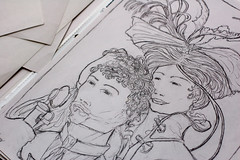 It didn't bother me at all. Seriously. I had my books and my clipboard and I devoured them. I even adopted the style in drawings, patterning the treatment of hair after Mucha, and adding the little white border around figures as seen in the poster style of the period.
 My tastes changed after a couple of years obsessing over the style and its period. I just stopped really getting into the style. I no longer had a little lift in my heart when I come upon a new work of Mucha's that I hadn't seen before.
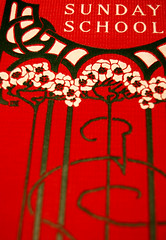
So I no longer obsess over Mucha and Guimard and De Feure, but I still like the style. It's no longer my favorite, but I still will buy a nice old piece if it has a good design on it. The little orange and gold and turquoise gilded and enameled bulb vase, in the top picture, was something I found for two dollars in Ft. Pierce Florida in an antique shop I used to frequent as a much younger person. The place has changed as much as I have since I was last there.
I think, though, that a little of the Art Nouveau ideas have stayed with me. So when I saw the little vase in January, I bought it. It happily co-exists with the mishmash of stuff that I have.
But that's okay. It's fun in my weird dimension and I like it here.
Sunday, November 29, 2009
St. Augustine
No matter how much of a tourist trap St. Augustine, Florida, can be, there's something about the place that I really do feel a love for. In the 1880s Flagler had a vision to turn it, along with Miami, Clearwater, and Tampa, into the finest watering places of the South. What he built in all of those places has left an indelible legacy on the Florida landscape - but in St. Augustine, he made something fantastic, there on the Alameda where the once great hotels that he built still stand: The Ponce de Leon, the Casa Monica and the Alcazar. It's a fantastic center of nineteenth-century architectural revival style can be seen and experienced, a revival style that has all of the beauty and the pleasantry that all but disappeared after the 1893 World's Fair, when style that the fair introduced crushed the originality in architecture that the 1870s and '80s had brought about. It's kind of sad, really, what happened there, but I'll save my thoughts on that for another day.
This is a bit away from the Alameda (the original name of the great landscaped square that all three of the Flagler hotels face on.), on the old city square, this is the former First Nat'l Bank Building of 1928. Today, it's been re-dubbed the Wachovia Building. It's still, however, very much of its time. The shadow on the lower side of the building is the shadow of old Cathedral bell tower. I rather like the cream and the red contrastiness against the blue sky.

This is a bit away from the Alameda (the original name of the great landscaped square that all three of the Flagler hotels face on.), on the old city square, this is the former First Nat'l Bank Building of 1928. Today, it's been re-dubbed the Wachovia Building. It's still, however, very much of its time. The shadow on the lower side of the building is the shadow of old Cathedral bell tower. I rather like the cream and the red contrastiness against the blue sky.
Thursday, November 26, 2009
Southern Snow
My Paternal Grandma lives in deep rural southeastern Georgia, on land that her family has lived on for at least a hundred years. Almost every year, we go up for Thanksgiving, and almost every time, there's cotton covering the fields, ready for picking. Getting there means driving through miles and miles of fields covered in the deep browns and the bright whites of cotton. It's like snow. Southern snow.
Happy Thanksgiving, everybody.

Happy Thanksgiving, everybody.
Wednesday, November 25, 2009
Daguerreotypography

Note: while I do know that the actual, correct term for the title is Daguerreotypy, I’m a real sucker for word bigness. So let’s just revel in the bigness of it all.
Since it HAS been well over a year since I last made a major entry in this blog (that would be classified under the category of ‘Oopsie,’) I thought I’d begin at the beginning. The beginning of photography, that is. Which I guess is natural, because I consider myself a photographer. And many consider the beginning of photography as being the Daguerreotype process.
My own personal love affair with the relics of photography’s first widely successful process began about four or five years ago, when I worked in an antique mall in Cocoa, Florida. I spent nearly a year there and loved pretty much every day of it. Anyone who knows me knows that nothing could make me happier than being able to spend a day combing through a bunch of old junk and non-junk, plus it was a way to be productive rather than just feeling like a slacker most of the day.
There’s something instantly recognizable about the Daguerreotypes (and Ambrotypes) of the mid-nineteenth century. And it’s not exactly something that a developed eye for things has to spot. Most Daguerreotypes and Ambrotypes, after their images were fixed to their plates and the photographic part of production complete, were placed in pressed leather or thermoplastic cases. Within the case, the image would be sealed in a pressed brass mount under glass. The protection of the image is two fold: Daguerreotypes had a silver-coated surface that is extremely sensitive to scratches and handling – and dings could probably damage the coating to the point of knocking some of it off. The cases provided protection against both of these: the soft pressed leather over scrap wood protected the plate from dings and dents, and the glass seal with their beautiful pressed brass mats protected the plate from handling: Fingerprints, scratches, etc.
It was these two attributes that I spotted and recognized instantly while working in the shop. A dealer had four or five cased images that I thought were Daguerreotypes. I was very, very much tempted by them, but I couldn’t afford buying them. Unfortunately, before I could pick them up, the dealer retired and moved out of the antique mall.
In retrospect, I didn’t realize that most of those cased images were actually Ambrotypes, images produced by a process that would come to replace Daguerreotypy by the late 1850s. I learned that lesson years later. It was actually this year that I learned it*.
In January I was in Melbourne, feeling tempted by nineteenth-century magic lanterns and old bell-pulls and a set of cast iron closet hooks. (Sounds less interesting than it actually is, a set of swiveling metal closet hooks that are mounted into bead-moulded slats that are part of the side of nineteenth century living that I adore, but no one hardly ever gets to see: the utilitarian side of nineteenth-century living.) Knowing I couldn’t afford all I desired (no one can, really. But isn’t there some sort of life lesson to be had there?) I walked into another antique place, and looked through the shelves.
A bowl, silver, was piled with odd square things that I didn’t recognize just by a glance and nearly missed beckoned my attention. I stopped, looked more closely, and found the bowl full of Daguerreotype case halves, all pressed leather and paper, all beat up and worn, empty of the silvery images that they once housed and protected. I started to look through them, and I didn’t see a price. I blurted out, after asking about the price on them, how much they wanted for the whole bowl of them. And after hearing “ten dollars,” I got all excited.
I stood at the desk, gushing internally. I kind of forgot the magic lantern (regrettably, I think, now) as I watched the lady at the desk pour the tattered leather squares into a “thank you thank you thank you” bag. I didn’t want the bowl and I wasn’t paying for it. I thought it was ugly, but its contents made me extremely, extremely pleased.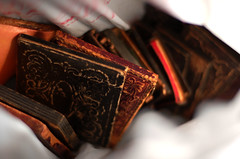
I didn’t get excited because I thought the damaged plate was valuable. I don’t shop for antiques like that. I only look up values of certain items when I want to make sure that I WAS justified in spending the money that I did on certain things. It’s kind of a self-justifying, enabling thing. I despise the Antiques Roadshow with a passion.
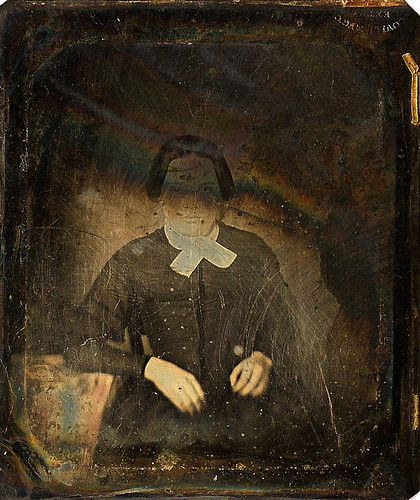
I knew the image isn’t valuable. Not just because of its damage, but because of the commonness of its image. Tens of thousands of young ladies went to get their daguerreotype likeness taken (advertised by some Daguerreotypists as paintings by the sun.) in their best dresses. Unless the dress is particularly fancy, or they happened to have not removed their bonnet in the studio (perhaps wanting to show it off to her friends, or wanting to preserve an image of herself in a favorite bonnet, as a bit of justifiable feminine vanity) or are carrying something remarkable, the image isn’t worth much. The Daguerrean expert who I e-mailed about my beat up Daguerreotype even told me the image wasn’t really worth restoring and resealing, because the cost of restoring and resealing the plate would far exceed its value.
But all the money mumbo-jumbo doesn’t matter to me. It’s my first Daguerreotype, and I love it. I have a thermoplastic “Union” case that had an empty brass mat and glass in it, that fit the Daguerreotype, so I matted it up and popped into one of the pressed leather case-halves that I bought that day. Just because I could. And because I like it. Because Daguerreotypes are kind of cool like that.
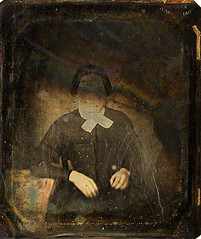
*This lesson, lest I forget to mention it, is that Daguerreotypes are typically on a copper plate have a mirror like surface, upon which the photographic image will usually only be seen once you look at it at about a fifteen-to-thirty degree angle. Ambrotypes are typically on glass, and do not have that mirror-like surface, their images are immediately visible upon opening up the cases in which they’re housed. They do, however, posses their own special qualities which I’ll write about later.
Tuesday, November 24, 2009
So, uhhh... it's been a year and two days everyone.
Anybody remember me?
Heh. Yeah, I kind of let this slip.
But I've been thinking lately of kicking it around again. And hopefully, not letting it sit for another year untouched.
Because that's kind of bad.
Really, it is.
Heh. Yeah, I kind of let this slip.
But I've been thinking lately of kicking it around again. And hopefully, not letting it sit for another year untouched.
Because that's kind of bad.
Really, it is.
Saturday, November 22, 2008
I spent hours working and all I came up with is this?
I spent hours working and all I came up with is this?
Originally uploaded by Decrepit Telephone
January Sixteenth of 2009, at Royal Oaks Country Club in Titusville, is the big splashy gala for this where my photographs will be seen. They are going to be projected, and I'm the one preparing the projection sequence, and that's what this video gives a sampling of - although the projection won't have the music. That's for mood (and I believe there's going to be a string quartet playing the gala evening.)
So, this is partially the reason I've been not very good at posting regularly to my blog. Because this has been what's been taking up a lot of my time recently (no not this little video). And I've had a few headaches over this due to some errors in communication and such, but what big project like this is ever without them? I've worked through them and hopefully it will all work out and look nice in the end and everybody will come out sane after the gala night.
Oh - and the gala night is invitation only. If you want an invitation to it, let me know. A tax-deductible donation of $50 will guarantee your RSVP. And it'll be nice with heavy hors d'oeuvres and such, and I'll be there too. So lemme' know. After the gala, the exhibit will move to the Library at the Titusville campus of Brevard Community College - anybody who goes to the Birding Festival there, can go and see it, but there won't be heavy hors d'oeuvres and stuff...
_____________________________________________
I am dang proud of that logo.
Wednesday, November 19, 2008
It was that time of year again...
Personal garbage has gotten in the way of a lot of things recently, but I want to update this much more regularly soon. After my trip to NY or just before, maybe that will happen. Who knows.

Wednesday, October 1, 2008

After much difficulties with time constraints, and computers crashing - the second blog post is finally up. Darnit.
My photographic muse is the Pritchard House, constructed over the summer of 1891 in Titusville, Florida. For nearly all my life I have been fascinated by the house, the history of which, up until recent times, was completely unknown to me - and now, today, I'm involved in its restoration to become a house museum - and anyone who has been fascinated by the place can come and discover it.
_______________
Parks and Recreation wants to add a catering kitchen to the Pritchard House, the addition of which would result in the loss of the maid's passage, an integral and important part of the Pritchard House's layout. The loss of the Maid's Passage would permanently alter the historic integrity of the house. Please e-mail Commissioner Scarborough, and the North Brevard Parks and Recreation Director and support not altering the Maid's Passage to make way for a catering/serving kitchen, a facility that is not in the true spirit of a historic house museum.
Friday, August 22, 2008
Your Host
Not the Brownie Starlet, but the guy behind it.
Hopefully, this will be the start of something that will be at least mildly interesting.

Hopefully, this will be the start of something that will be at least mildly interesting.
Subscribe to:
Posts (Atom)